Showing posts with label sleep study. Show all posts

Monday, April 4, 2016

The Return of Ellie Bellie Bear : Updates all around

Two months!  Yes, I have been gone for 2 months, but that is because we have been busy.  Both a good busy and a crazy busy!

I'll start off with Ellie is doing very well. Since Bear had her airway surgery back in November for sleep apnea (lingual tonsillectomy and glossectomy), we have seen progress in various areas of development.   We believe that is because her sleep quality has improved because prior to her surgery, Ellie maintaining oxygen saturations at 80% while sleeping.  Normal is 98-100%.  This means that her brain was not getting enough oxygen, which obviously leads to several health issues.

Since her surgery, Ellie has gained nearly 2 lbs and has grown in height!  Happy dance!  Her sleep pulmologist theorized that part of Ellie's failure-to-thrive was related to her apnea.  Unfortunately, she is still quite underweight each pound is a battle - to  gain and maintain - as her GI issues also play a role.
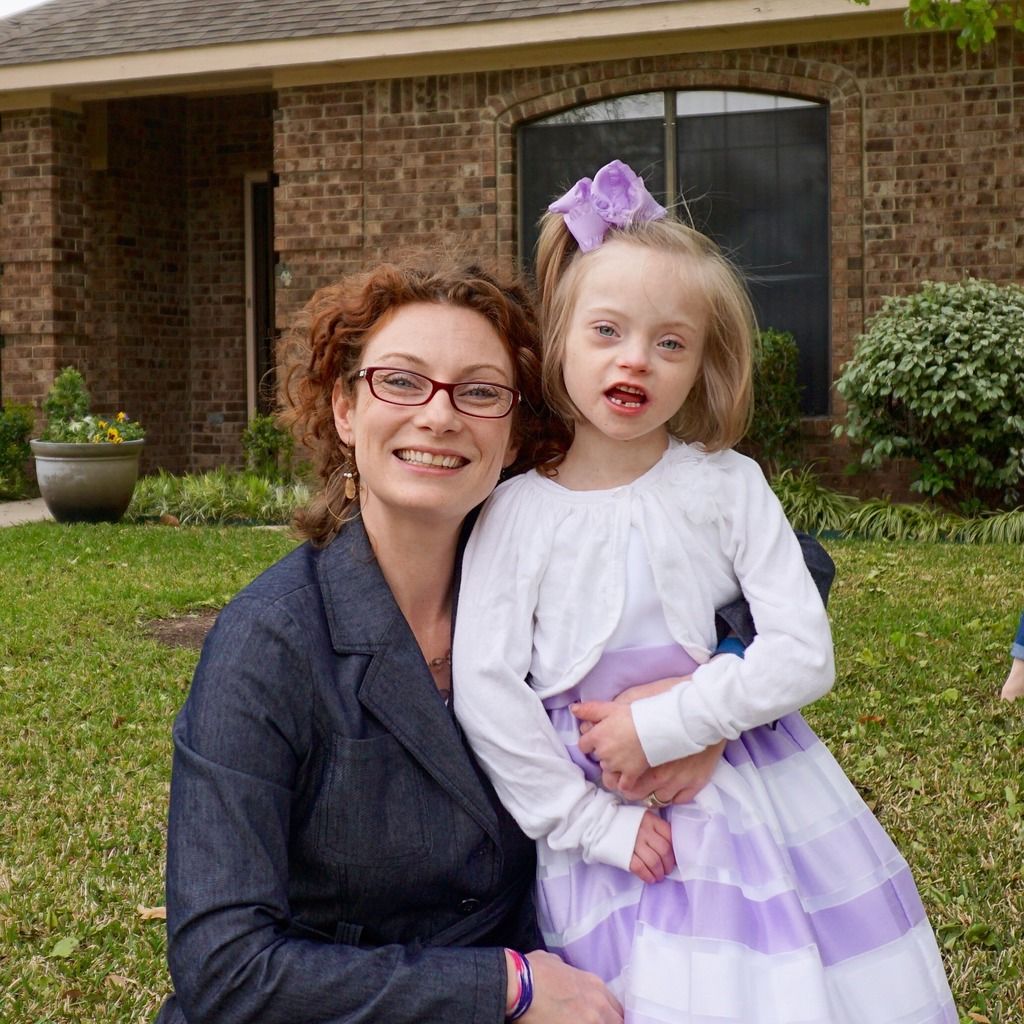


This brings me to speech!  I kid you not, remove the lingual tonsils, de-bulk her tongue and Poof!  the child is trying to formulate more words.  This child is cursing like a sailor.  Yep, she takes after me.  I knew I should have curbed my cussing around her!

A typical Ellie conversation: (please note that the Bear does not know how to modulate her voice so it is all practically shouting)

Ellie: F*ck!  F*ck!  F*CK!
Me: You want to ride in the TRUCK?
Ellie:  F*ck *ss! [Truck Yes]

In a restaurant:
Ellie: F*ck F*ck F*ck
Me: What?!  What?!  I see no truck.
Ellie: F*ck (signs fork)
Me: Oh you want a FORK!
Ellie: *ss

I'd love to tell you all that I am embarrassed by her crud words, but really, I struggle not to laugh.  It is funny. She is trying so very hard and I am proud of her.  I just loudly repeat back what she is trying to say so that the people around me recognize that my kiddo is really a "polite little angle". *snort*


GI Issues / Upper Endoscopy Results:

Well goodness, I left you all hanging with the upper endoscopy and ruling out celiacs and whatnot.  You know how you go in expecting to find something, but instead come across something different?  That is Ellie.

The gastroenterologist took 7 biopsies from Ellie's upper GI tract - esophagus, stomach, duodenum (upper portion of the small intestine).  Celiac's disease, lactose intolerance, and H. pylori were all officially ruled out.  He did, however, find marked inflammation of the esophagus and stomach.  He has no explanation for this other than perhaps it is lingering gastritis from a prior infection or maybe a side effect one of her medications.

Here's my thought - July 2014, Ellie stopped eating.  Just stopped.  She was taking in approximately 300 calories a day.  She would get a bit better and then her appetite would disappear.  In July of this past year, we started her on Periactin, which is an antihistamine that also works as an appetite stimulant.  Fun Fact: antihistamines decrease the release of histamine.  Histamine regulates the release of gastric juice.  As a result, antihistamines (such as benadryl, Periactin, Zyrtec) can help with nausea.

Anyway, my thought is that The Bear's esophageo-gastritis started back in July 2014.  That her inflammation was so bad that it hurt to eat. So, she basically stopped and then lost a lot of weight.  Nonetheless, she is on Protonix, a proton pump inhibitor, which is used to treat reflux and ulcers.  This will allow her stomach and esophagus to heal.  She has just one more month on the Protonix and then we shall see how does.  We have several GI appointments coming up with 2 different doctors as Ellie is still battling severe constipation and we have plans to do more extensive testing come June.


Semi-related to GI, for the past 5 days, Ellie has been peeing 2-3 x day.  This is a marked improvement over her peeing every 24 hours.  Like her urologist, I do believe the constipation does contribute to the urinary retention.  Yet, I do wonder if some of her medications also play a role.  Nonetheless, I am hoping that we can start working on potty training soon because it is time to say good-bye to pull-ups!


Back to sleep - yeah, I know.  I already waxed and waned about the sleep.  Sleep is so important and if Ellie isn't sleeping, no one is sleeping!  Bear decided to return to her old habits of early awakenings for most of late December into February. This was the whole waking up at 2:00am and partying until 7pm that night.  Do you know what sleep deprivation does to a child?  It is like ADHD on steroids.  It is as though I never gave her the Adderall.  She is wild, impulsive, inattentive, and irritable!  There were several phone calls to the sleep pulmonologist and a visit in there as well.  We finally seem to have a handle on her sleep, which has made a world of difference.


Fun Stuff:

Spring Break was a grand ole merry party.  First up, Ellie had a repeat sleep study.  Because we know how to have a great time on spring break!  Her sleep pulmonologist and airway ENT want to see how things are going after her surgery.  Ellie was a rockstar! Oh yes, she fought us tooth and nail with each electrode being placed, but she was able to calm herself down in between.  She also SLEPT!  We do not have the results yet, but I am feeling pretty positive.  Yikes!  I hope that I didn't just jinx everything!


Aside from all these fun medical things going on, Ellie has been enjoying her weekly horse therapy sessions.  She is getting better at guiding her horse using the reigns and saying words.  She had a dance recital last month and actually danced.  She did not run off stage.  She did not try to crowd surf.  She did not try to break dance like last year!  Ellie went with her kindergarten class to the children's museum and did great - meaning she didn't run away from her aides and she played nicely with her classmates.  All in all, even with all of the medical issues that the Bear is experiencing, she is thriving and happy!


 photo IMG_2291_zpsudykfi0h.jpg

Follow us on Facebook!
https://www.facebook.com/pages/The-Chronicles-of-Ellie-Bellie-Bear/216738345037166

Monday, April 20, 2015

CPAP for Obstructive Sleep Apnea

*I apologize in advance for some missing photos - I used Photobucket for free as a means to store my photos and they are now holding a few hundred pics of mine for hostage unless I pay for an expensive plan and I also managed to lose half my photos from my computer*

Has it really been over a month since I last blogged about Ellie's sleep issues???  Apparently, it has.  This is where we left off: Treatment plan and health risks associated with obstructive sleep apnea [OSA].  To learn more about Ellie's sleep issues, read here.  But first, a few little photos from Easter:


We finally got in to see Ellie's ENT doc at the beginning of March.  Her sleep specialist fought to get her an appointment back in mid-February, but the ENT was out of town.  Anyway, the purpose of the ENT appointment was to evaluate whether or not Ellie's adenoid had grown back.  If so, we would then proceed with a repeat adenoidectomy (because surgery is so much fun!) in hopes that would "cure" her OSA and "oxygenation instability".  I had 2 choices: lateral neck x-ray or a flexible nasal laryngoscopy.  I went with the laryngoscopy.  Yes, it sounds mean, but it is quick.  It provides more detail information.  Plus no radiation is involved. Plus, I have this perverse obsession with seeing people's insides (it is the nurse practitioner in me - especially being a former ENT NP).

Ellie's procedure was the pic on the right.

This is how it went: the nurse kindly sat with Ellie.  Her legs over Ellie's and her arms around Ellie's. I then stood behind the nurse with my hands holding Ellie's head straight. Now, a laryngoscope is essentially a spaghetti-like noodle with a camera on the end.  It passes through the nose and looks at the structures of the upper airway.  It can be used to diagnosis enlarged adenoid and tonsils, enlarged base of tongue, laryngomalcia (floppy airway), abnormalities of the vocal cords, and even reflux.  How did Ellie Bear do, you ask?  Well, she fought it all while screaming "NO THANK YOU!  NO THANK YOU!  NO THANK YOU!"  Girlfriend is nothing, but polite.

The findings were not what I was hoping for.  It may sound strange, but I wanted that adenoid to be there.  She is obstructing.  She has had nearly nonstop sinus infections again since August.  If it had regrown, we could have "easily fixed" it.  Nope.  The adenoid did not grow back.  While she does not have an abnormally large tongue, she does have a large tongue base.  She also has not only a high arched palate, but a long palate that dips into the upper airway.  At rest, between the tongue base and the palate, she is already in a partial obstruction - this is while awake and upright.  With sleep, the muscles relax and while laying down, it allows everything to collapse back into her airway.  We also learned that she had reddening of the epiglottis suggesting reflux.  Goody.

Depicts large tongue base causing obstruction of air flow
Photo courtesy: Dental Magazine - unable to find vol #

Take the above pictures and add it to the pic below and that is Ellie's anatomy

Depicts soft palate obstructing air flow

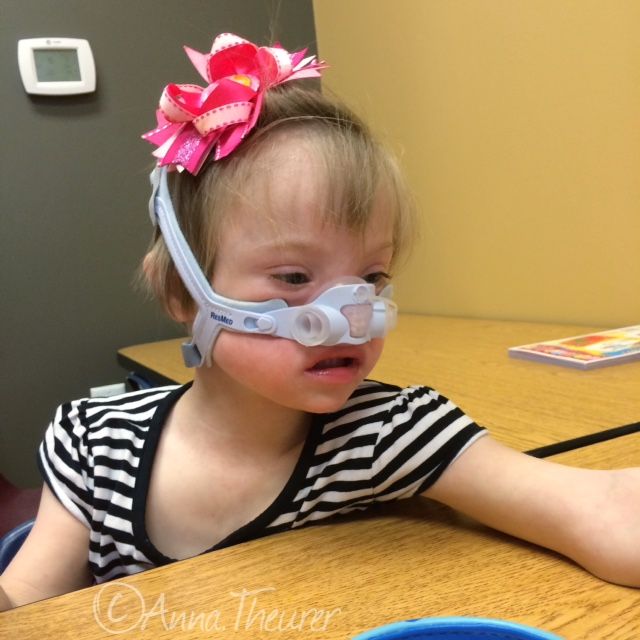
So guess what we have been doing these past few weeks?  CPAP mask desensitization!  The fun never stops.  By the time all was said and done - the doc writing the script, insurance approval, equipment ordered, and equipment training, we finally started on March 26th to desensitize Ellie towards wearing her CPAP mask.  Let us pause for a moment to think about how that.  Desensitize.  Ellie.  Is it going to take years like bath desensitizing did? Save me now!

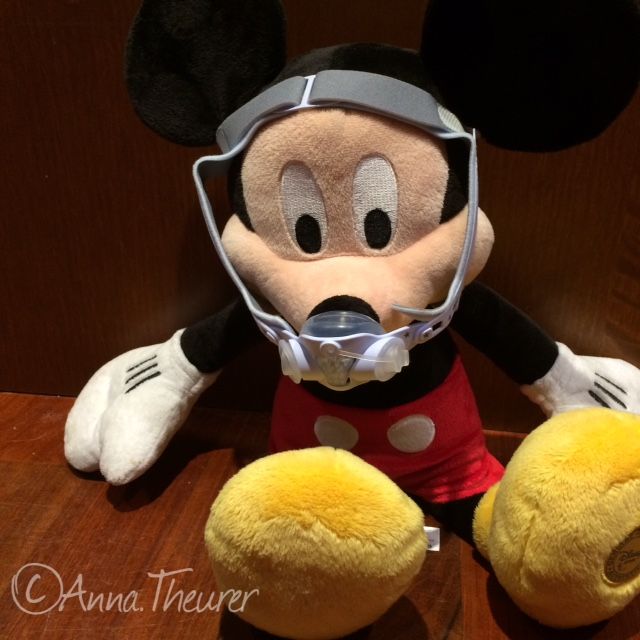
It's Fighter Pilot Mickey


Continuous Positive Airway Pressure [CPAP] is considered to be a type of ventilation therapy in which positive pressure is blown into the airway as a treatment for obstructive sleep apnea.  We are trying what is called a "Pixi" mask.  This is a mask that fits over her nose only, as opposed to a mask that fits over both the nose and mouth.  You need to create a tight seal or otherwise the pressurized air will leak around the mask.  If she starts to mouth breath, the air will escape so there is a strong possibility she will need the full face mask. 

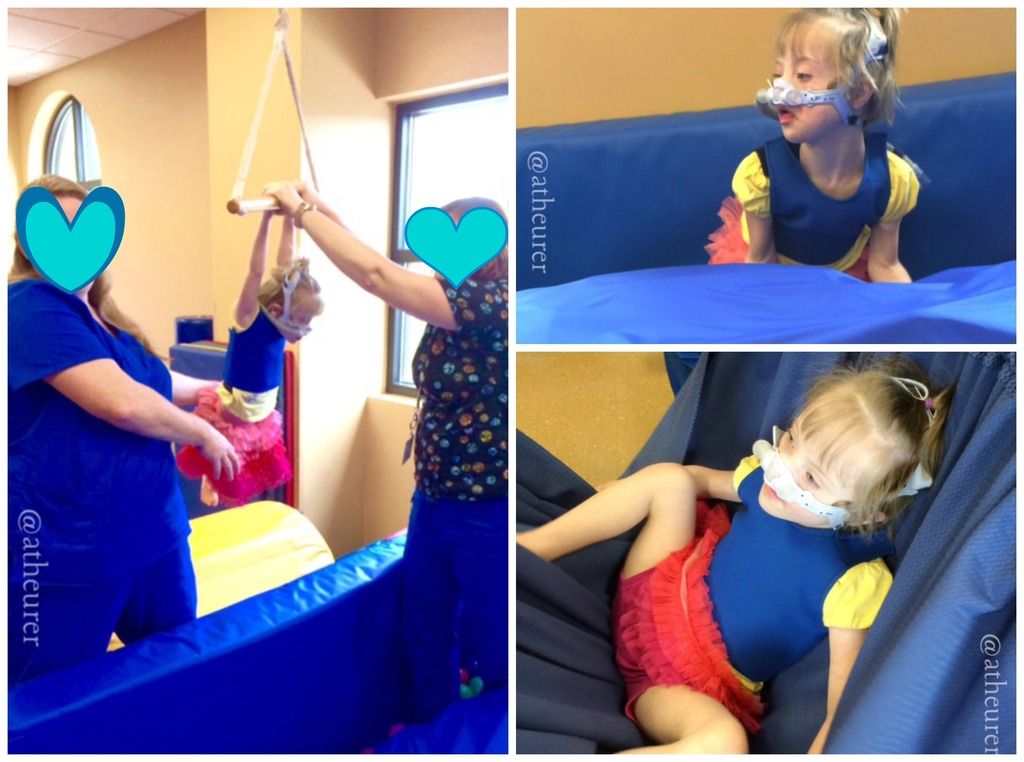
During Speech and OT.
We have adjusted it since then so that it isn't digging into her face.

You can just imagine how this is going.  My daughter has some significant sensory avoidance issues when it comes to her face, hair, and head.  Tooth brushing requires some interesting gyrations, which involve my legs over hers and my arm holding down her arms.  Combing or washing her hair is considered a form of torture.  Now she has to wear a mask over her face?  One that blows pressurized air into her face?  Right. . . 

Co-therapy between speech therapist and occupational therapist
in the sensory gym.  Also trying out a compression vest since Bear has
been behaving like the Tasmanian Devil on steroids.

So desensitizing is a  s l o w  process.  A step by step approach.  Ellie is to build up to wearing her mask for 15-20 minutes, 3 x day.  Then we add hooking it to the machine and turning it on - again 15-20 minutes, 3 x day.  After that, falling asleep with the mask hooked up to the machine and turned on.  We are making progresses. . . sort of.

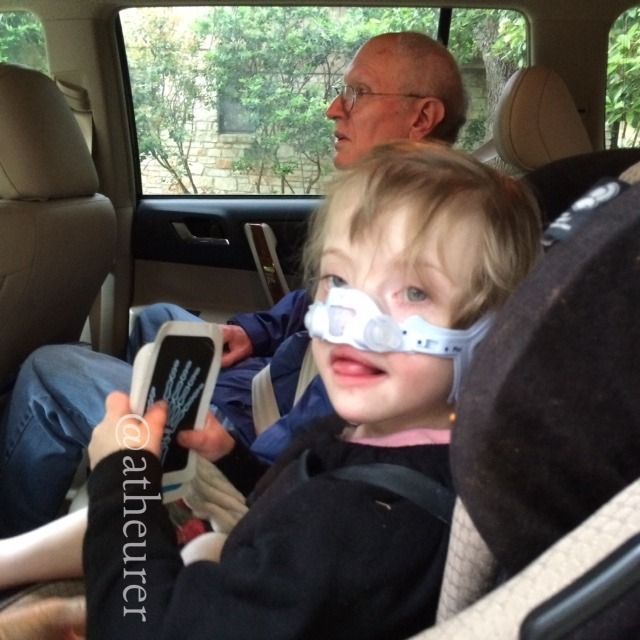
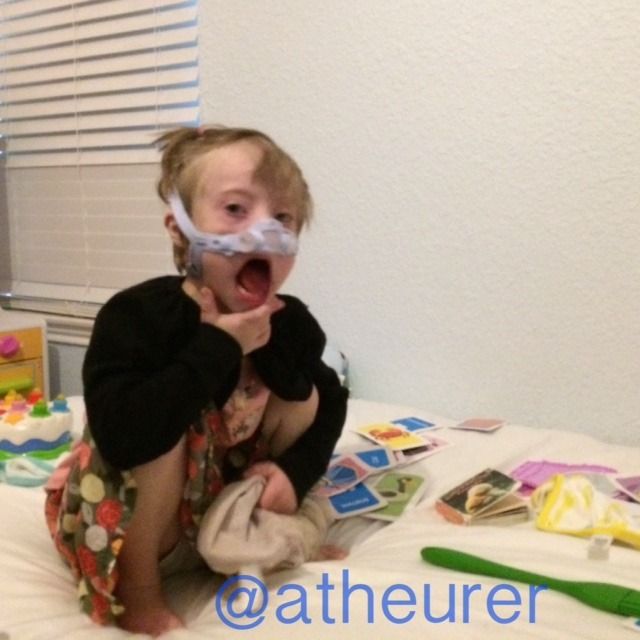
"yeah, I'll totally wear it if Papa is next to me."

At therapy (ST/OT), she will wear the mask without too much difficulty.  She has worn it for 2 therapy sessions for ~30 minutes!  At home, she will touch it, but shout "NOOOOO!" when she sees me hold it.  She will allow Mickey Mouse to wear it. She will try to put it on Minnie Mouse.  Once, she tried to put it on herself - in the waiting room at therapy.  Apparently, she associates therapy with the CPAP mask now.  Once, she allowed me to put the mask over her face just before we went for a ride in the car.  I am also able to place the mask on her once she is already asleep, but am not able to turn on the actual CPAP.  Progress is progress.  No matter how slow it is.  

Traitor!  You said this would be fun. You said I was going to be a fighter pilot.
Our sleep doctor told us to follow up in 2 months time.  It is said that if she will not wear the mask with CPAP within 2 months, she will most likely never wear the mask (well at least in the near future wear the mask.  Maybe in 10 years she'll wear it, but that doesn't really help the now).  That means Ellie would have something called a Cine MRI, which is basically an MRI in motion to look at the airway while the patient is under deep sedation.  The Cine MRI helps determine if surgery is necessary and if so, what part of the upper airway needs to addressed.  So yeah, I want the CPAP to be tolerated and to work.


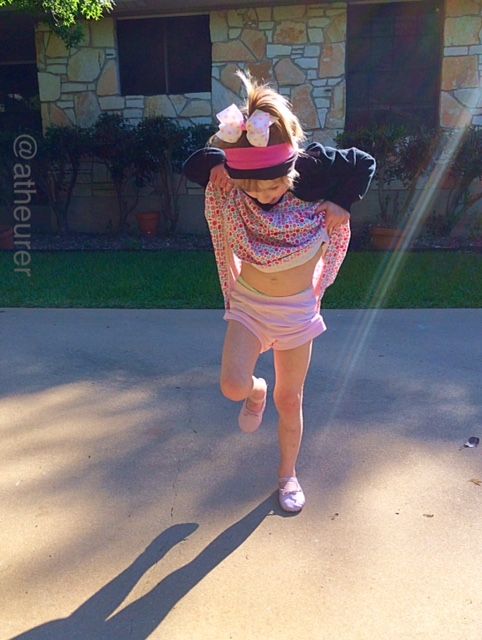
My little dancer who recently discovered her shadow.


Photobucket

 Follow us on Facebook! http://www.facebook.com/annatheurerfitness http://www.beachbodycoach.com/annatheurer https://www.facebook.com/pages/The-Chronicles-of-Ellie-Bellie-Bear/216738345037166
Tuesday, February 24, 2015

Part 2: Treatment Plan and the Health Risks Associated with Obstructive Sleep Apnea


The sleep study results landed Ellie with the official diagnosis of Obstructive Sleep Apnea with hypoventilation and oxygenation instability.  Isn't that a mouthful? 


Obstructive sleep apnea [OSA] and sleep disordered breathing [SDB] can have a huge impact on health.  Actually, it can be very detrimental to one’s well-being.  I still shutter when I think about what Ellie is at risk for if we do not treat her OSA.


The symptoms above are what we in the health care field refer to as "red flags".  Some of the symptoms may mean nothing at all or may signal a sleep disorder.   Yes, snoring is a sign of OSA, but not everyone who snores has OSA and not everyone who has OSA snores.  That being said, chocking and gasping while sleeping is a neon sign indicative of OSA.

In addition to the signs listed above, kids can present with a few other symptoms (Ellie's are in purple): 
  • anger control issues
  • difficulty swallowing 
  • irritability
  • daytime sleepiness
  • frequent runny nose
  • mental brain fog
  • hyperactivity
  • impulsivity
  • inattentiveness
  • poor school performance
  • memory loss
  • headaches
  • learning difficulties
This pic is from 2 years ago before her T & A.  Notice that she is propping herself up or sitting up to sleep?
These are also signs of sleep apnea in children.

If you have been following this blog for any amount of time, you know that my daughter has severe ADHD  and had shown signs prior to turning 3 years-old.  You also know that when she has poor sleep, it is like ADHD on steroids—as in it is like she never took her Adderall.  Her ability to function at school is pretty much nonexistent.  She has trouble participating in class.  Trouble sitting in circle time, lunch, art, music, therapy.   Trouble concentrating and following directions.  Impaired social interaction as she is “grabby, impulsive, irritable”.  

In fact, studies (several posted in the medical journal Pediatrics between 2009-2013) suggest that there is a blurring of lines between ADHD and OSA. According to the American Sleep Apnea Association, at least 25% of children misdiagnosed with ADHD actually have a sleep disorder, specifically obstructive sleep apnea.  This may be because poor sleep may damage neurons within the prefrontal cortex of the brain.  I have no doubt that Ellie’s sleep apnea and early wakings manifest as ADHD behaviors.  All of that being said, I do believe that she has underlying ADHD just because of our family history.  It makes me wonder though, if we treat her OSA and we treat her ADHD, how well will she do in school?  How will her friendships evolve?  How will our home life change and be improved?

Photo: ADHD Caregiver Day


This goes beyond behavior though.  Obstructive Sleep Apnea MUST be treated.  It CANNOT be ignored.

Untreated OSA and the resulting high levels of inhaled CO2 and poor oxygenation can lead to:

  • Increased heart rate and blood pressure
  • Cardiovascular disease
  • Increased risk for stroke
  • Increased blood pressure
  • Unstable blood glucose and insulin levels, leading to diabetes
  • Memory loss
  • Kidney problems
  • Hormonal imbalance, especially with testosterone


All health issues that can eventually lead to poor quality of life as well as death.  Death! Oh goody.  Bear is only 5 years-old, so what will her life be like at 20, 40, 50 if this isn't managed?!

In children, the usual culprits are enlarged tonsils and adenoid obstructing the upper airway.  Nearly 2 years ago, this April, Ellie had a tonsillectomy and adenoidectomy [T&A].  She had a never ending sinus infection that was resistant to antibiotics and nasal sprays and it lasted months.  She also had frequent ear infections that have required a set of ear tubes every 6-9 months.  In those last 2 months leading up to her surgery, she was propping herself up to sleep.  The T and A  essentially cured her.  After surgery, she didn’t have a sinus infection for 11 months.  ELEVEN months!  Ellie’s last set of ear tubes was in April 2013. 


Sadly, all of that has changed.  This past August is when she started up again with the recurrent, frequent sinus infections.  August is also when her sleep issues started.  She had fluid in her ears this past fall and an ear infection around Christmas.  In December, I asked her ENT doc if her adenoid might have grown back. . . I was told it is rare and too soon.  We were advised to wait until the summer and if she was still having sinus issues, we would reassess. 

Oh yes, I did say it. THE ADENOID CAN GROW BACK!  Yes, it isn’t common, but I laugh in the face of low percentages and low risk.  After all, my odds ratio of having a child with Down syndrome was 1/1300.  A 2011 study in Laryngoscope, show the rate of adenoid regrowth requiring a secondary adenoidectomy to be 1.3%.  Another study in the International Journal of Otolaryngology revealed that those with adenoid regrowth tended to be younger at the age of their initial adenoidectomy as well as had a much larger adenoid than the general population.  Ellie was 3.5 years-old at the time of her T&A and I was informed that her adenoid was “very massive with extreme crusting” aka large and nasty. 


Ellie’s Treatment Plan :

  1. Follow up with ENT to rule out adenoid regrowth and palate abnormalities.
  2. If there is no adenoid regrowth, begin desensitization for CPAP (more on that later.)
  3. If CPAP is not tolerated, discuss further surgical options dependent upon cause of obstruction a. Palate Surgery for long palate obstruction  or  b. Genioglossus advancement aka base of tongue advancement surgery.  Again, more on this later


Ellie’s Sleep Doc wanted her seen by ENT the week we got her results (2/9) or last week.  Unfortunately, her ENT is out of town for the rest of this month.  Thankfully, ENT and sleep doc coordinated and made sure the Ellie is seen the first day Dr. Z is back in office.  So on March 3rd, Ellie will have her ENT visit.  Meanwhile, we have that many more days until we get answers and even longer before we can treat her OSA.


Bring on the coffee!


Part 1: Polysomnography, sleep study results, and obstructive sleep apnea

Tonsil and Adenoid Removal (T&A) Recovery Tips

From a few years ago--I want to go back to sleeping!


Follow us on Facebook!
http://www.facebook.com/annatheurerfitness
https://www.facebook.com/pages/The-Chronicles-of-Ellie-Bellie-Bear/216738345037166

Tuesday, February 17, 2015

Polysomnography, Sleep Study Results, Obstructive Sleep Apnea, and other things

Sleep Study Results Revealed and Explained

We have known about Ellie’s sleep study results for about a week now.  There has been a lot of information to process and of course, a lot of researching on my end.  (Hey, I used to order sleep studies, not interpret them!)

Oh where to begin.  For a recap of her sleep issues, visit here.  For more information about the sleep clinic appointment, visit here.

My little sleep deprived movie star.


According to the doctor:

Ellie is a 5 year-old with trisomy 21.  She has evidence of mild pediatric obstructive sleep apnea.  However, the patient has evidence of nocturnal hypoventilation and moderate-to-severe oxygenation instability as a result of her sleep disordered breathing.  She requires intervention for her OSA.

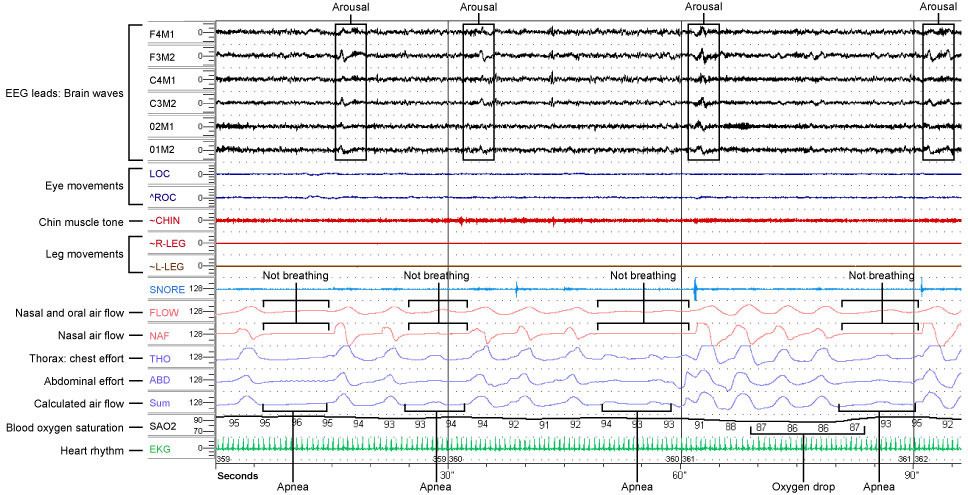
Polysomnography showing apnea with oxygen desaturations and arousals following apnea.
Photo: www.northcountryneurology.com

Translation:

Ellie sometimes stops breathing while she sleeps aka has apnea. According to her sleep study report, she only had 3 apnea episodes, each lasting approximately 10 or more seconds.  It is obstructive because her physical anatomy (small mid-face, tongue, palate, etc) affects her ability to breath while laying down.  Central apnea would involve a problem with the brain signaling the chest muscles to move and this type of apnea has been ruled out.  Pediatric apnea is defined as a pause in breathing.  In children, the pause can be any length of time while in adults, apnea is defined as pauses in breathing that lasts ≥ 10 seconds.  

Hypoventilation is the reduction of airflow by 50% for two respiratory cycles accompanied by reduction of saturation by 3% or arousal from sleep.  Right. So in layman’s terms, the amount of air that flows into the lungs is 1/2 of what it should be and as such, her oxygen saturations [SpO2] go down. 

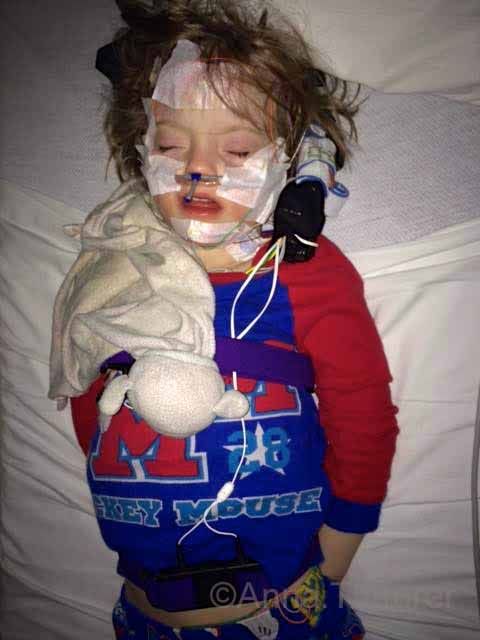
Ellie's overnight sleep study.  How can one sleep with all those wires?

Respirations, Carbon Dioxide, Oxygen Saturations: 

Ellie is diagnoses with nocturnal hypoventilation because she takes very few breaths while asleep and those breathes are very shallow aka she has hypopnea.  Each hypopneic episode lasted 20 + seconds. This causes poor inhalation and exhalation as well and a decrease in oxygen saturation.  

Oxygen Saturations:  looking at oxygenation levels during hypoventilation. Say that Ellie’s normal O2 sats are 100% (okay, her sats really do sit at 100%), if she drops to 97%, it is logged as hypoventilation ( or say when she dropped into the 80’s as seen during her sleep study). 

Carbon Dioxide Levels:  Breathing also involves the exchange of oxygen and carbon dioxide [CO2].  As you breath O2 into the lungs, you expel carbon dioxide out through your nose and mouth,  My daughter’s inhaled CO2 levels are very high.  For 81% of the time she is asleep, her CO2 levels are 50-62mmHG.  Normal CO2 is 35-45 mmHg.  Think of it as breathing face down into a pillow . . . for a huge chunk of the night.  

Respirations:  A normal respiratory rate for a 5 year-old is ~ 20 breaths per minute.  While asleep, Ellie’s was at 9-12 breaths per minute.  Too few breathes = hypoventilation = increase CO2 + decreased O2

Photo: www.proacthealthsolutions.com

Quantity vs. Quality and Arousal.

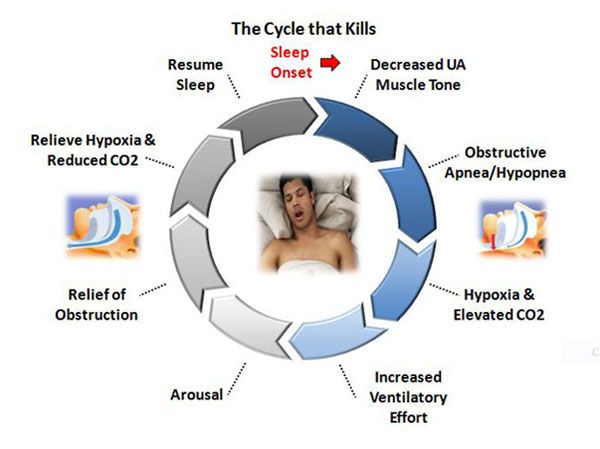
It should be noted that Ellie managed to sleep 7 hours and 48 minutes during her sleep study.  She fell asleep quickly and her arousal index was 15.1 (normal 9-16).  She spent 33.3% in REM sleep which is age-appropriate.  All of this is good, except REM sleep is where everything goes down hill.  Here is how it goes, your brain recognizes that your CO2 levels are rising, this causes an arousal.  With that arousal, you wake up a bit and trigger a bigger inhalation of air and thus increase your oxygenation and bring down the CO2 from the danger zone.  This is why people who have apnea tend to wake up alot through the night or never feel rested during the day.  Even if the quantity of sleep is there, the quality is not. 


Indexes Defined:

Apnea Hypopnea Index [AHI] looks at the number of apneas and hypopneas per hour of sleep.  For Ellie, her AHI was 4/Hr which placed her at mild OSA.  However, during REM, her AHI was >12/Hr which is severe.

SpO2 nadir is a fancy way of saying “the lowest SPO2 recorded”. Ellie’s lowest sat was at 81%.  This is not good, but it didn’t require intervention with supplemental oxygen during the sleep study.

Oxygen Desaturation Index [ODI] looks at the number of times per hour, a person’s oxygen saturations drop by 3% or more.  For Ellie, her ODI was 6.8 during stage 1&2, but then jumps to 9.5 ODI during REM sleep.  This is another reason why she has “oxygenation instability”.

Someone thought that should would take a little rest during dance class.

This blog post is turning into a term paper here so I will sign off now and write another post later on what the plan is for Ellie. 


Photobucket
 Follow us on Facebook!
http://www.facebook.com/annatheurerfitness
http://www.beachbodycoach.com/annatheurer
https://www.facebook.com/pages/The-Chronicles-of-Ellie-Bellie-Bear/216738345037166

Cecostomy Tubes R Us

Here we are - two posts in 30 days! It's scandalous, I tell you!  Seriously though, I bet you all thought that I abandoned ship and woul...