Showing posts with label T&A surgery. Show all posts

Tuesday, December 8, 2015

Ellie's Surgery for Sleep Apnea and Recovery

The month of November sped by while at the same time it, seemed to crawl along at a snail's pace.  There were too many things to worry about and I do not mean of the turkey being over-cooked  and a family feud variety.   No, I am talking about Ellie's surgery and my cervical steroid injection procedure.

As someone with a diagnosed anxiety disorder, it wasn't very difficult for the usual worrying and feelings of anxiousness to transcend into full blown panic mode complete with heart palpitations, nausea, sweating, and feeling of impending doom.  Then how the irrational suddenly becomes the rational.

*I apologize in advance for some missing photos - I used Photobucket for free as a means to store my photos and they are now holding a few hundred pics of mine for hostage unless I pay for an expensive plan and I also managed to lose half my photos from my computer*

In the past year, I have had several steroid injections into my back.  Nearly all of them have been in the lumbar (lower) region of my spine as well as my sacroiliac joint.  However, it was the first time I was having a shot into the epidural disc space a my neck in hopes of alleviating the intense neck/should pain with radiating numbness, tingling, and weakness down my entire left arm.  Epidural shots into the cervical region, as opposed to lumbar or thoracic, are a bit more risky given the close proximity of the brain as well as narrowness of the spinal column.  This of course triggered an intense sense of doom.  "It is going to cause a flare up that lasts through Thanksgiving and then I will have to cancel Ellie's surgery.  I am going to have temporary paralysis or a spinal headache!"


Then even more worrisome for me because it involve my baby, Ellie's surgery - the lingual tonsillectomy and glossectomy- which was going to commence exactly one week after my injection.  By the Friday before Monday's procedure, I had talked myself into believing that because I worried, fretted, and had horrid dreams about all the "what ifs"related to all that could go wrong with Bear's surgery and recovery, that I worried all possible complications away.  Of course, then I had myself thinking "well now I just jinxed it and something is going to go horribly wrong!"

As with most things, I worried for nothing.  My shot was awesome with a minimal flare up followed by 50% pain relief and 75% decreased numbness/tingling.  Ellie's procedure went well and she had a relatively smooth recovery.
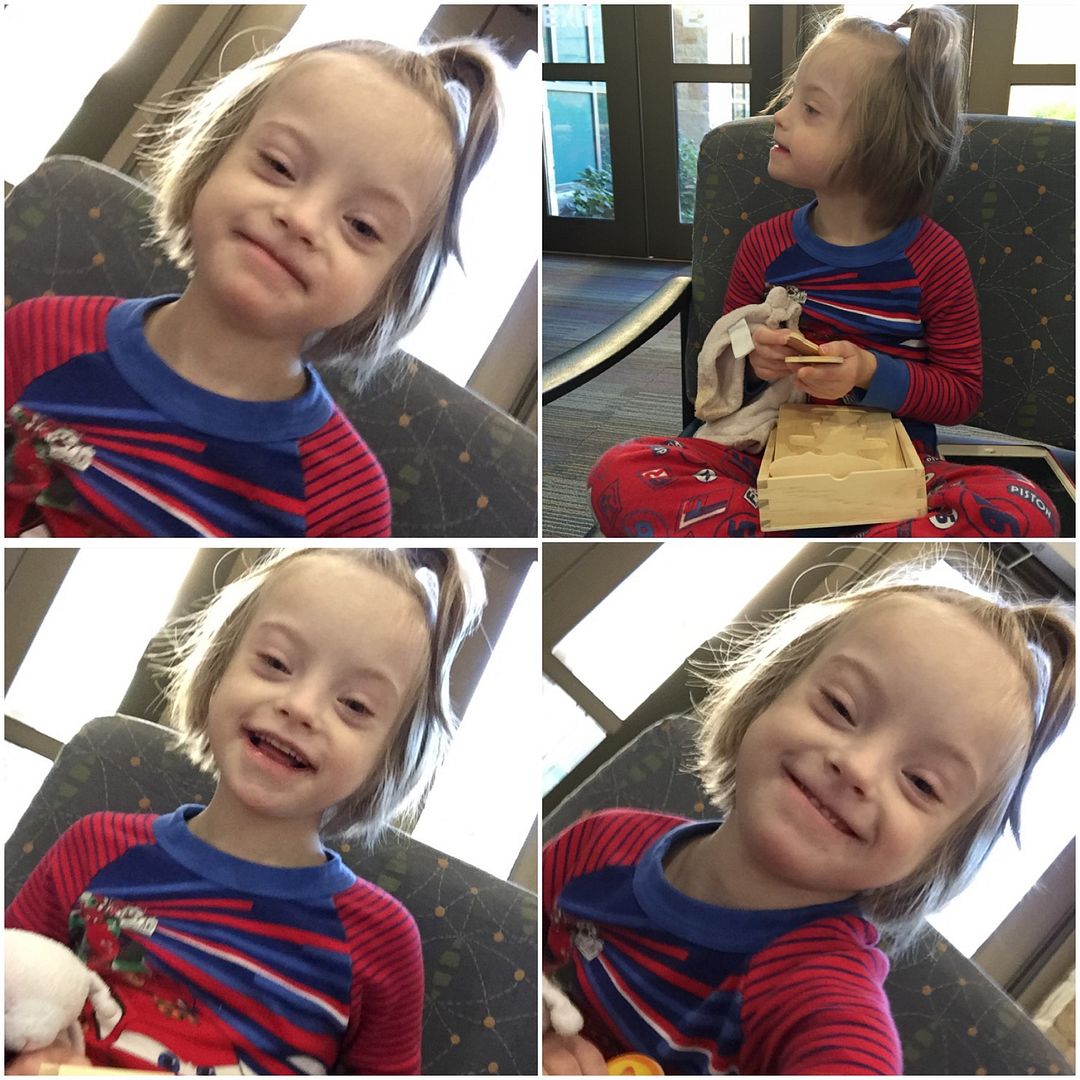
Pre-operative waiting room Selfies

Ellie's surgery lasted approximately 1.5 hours and she was a little stinker pants coming out of anesthesia.  Then for the next two hours she was agitated and screaming bloody murder.  Kicking, hitting and using her teeth to pull off the sock that was taped around her ankle.  The sock that was covering her pulse oximetry monitor around her toe - the little thing that measures the oxygen saturations in the blood (normal is 98-100%).  Given the thrashing that was already making it difficult of the pulse ox monitor to function proper, I respectfully asked if we could do spot checks every x number of hours rather than continuous monitoring and the doc looked weary.  I totally understand seeing as the child just had her upper airway carved on!  Yet, after spending just 5 minutes in the room with the Tasmanian Devil, the doc said "take it off and check her every 4 hours".

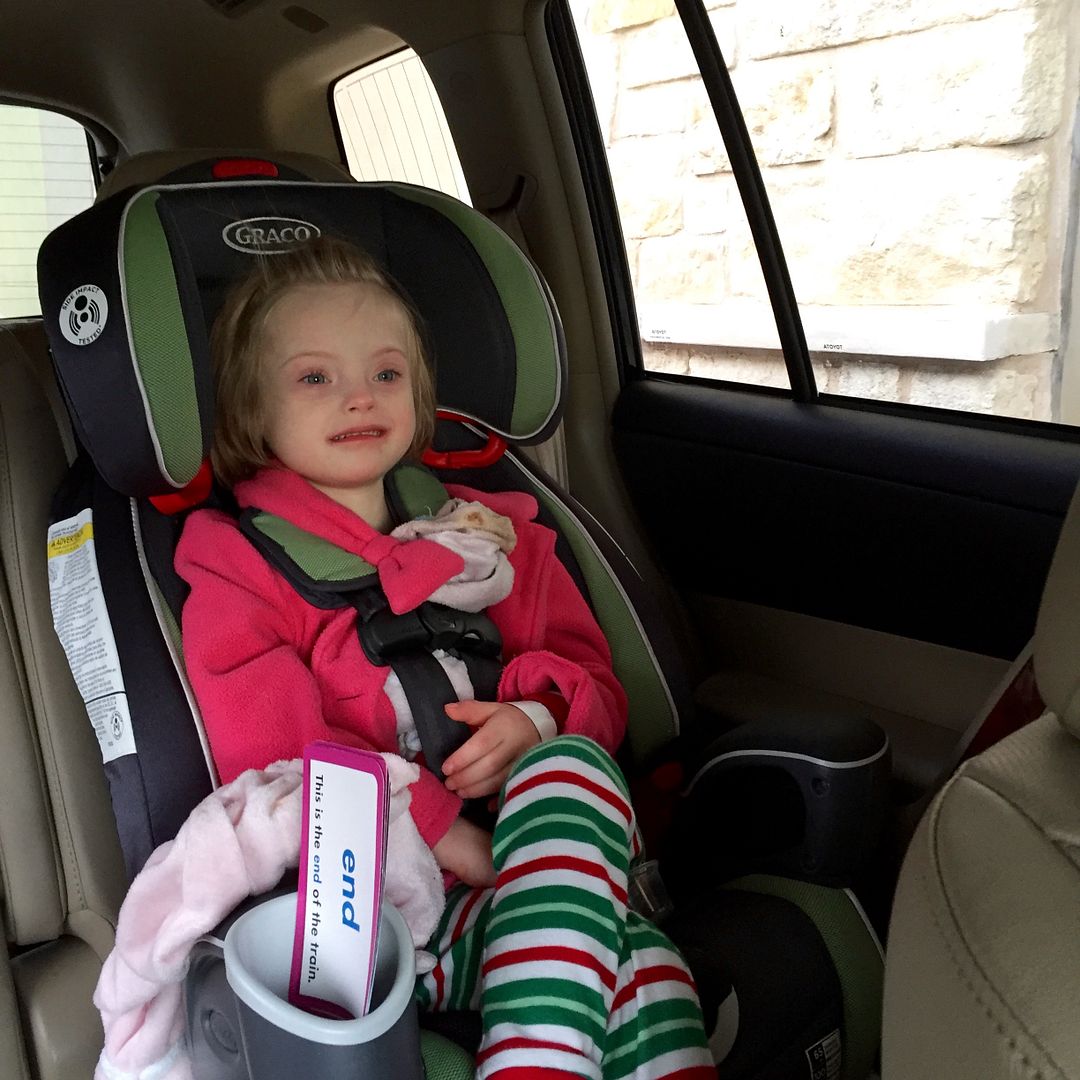
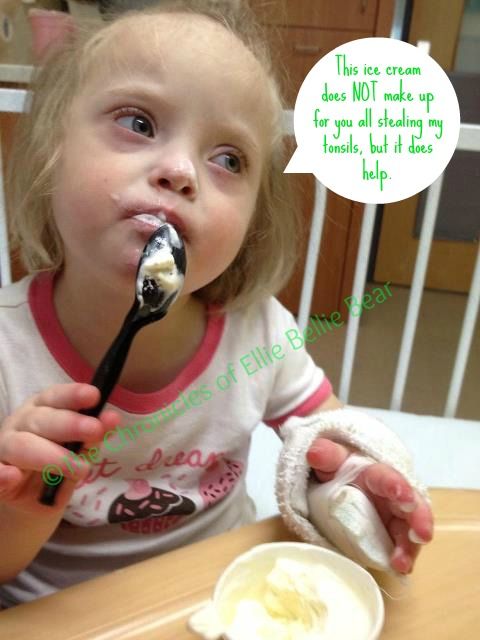
Once Ellie was calmed down using coloring books and watching Sofia the First, she ate some ice cream and drank a bit of juice.  She also started peeing!  As in she peed THREE times that day and 3 times the following day. This is something that we hadn't seen since July (yes, she is still doing that pee every 22-30 hour thing).  When we arrived in pre-op, Ellie hadn't urinated in well over 24 hours.  I knew from past experience that the anesthesia would cause a more acute urinary retention so I convinced the surgical team to perform a urinary cauterization in the OR if she didn't pee while under.  That cath seemed to be a cure . . . for about 3 days.

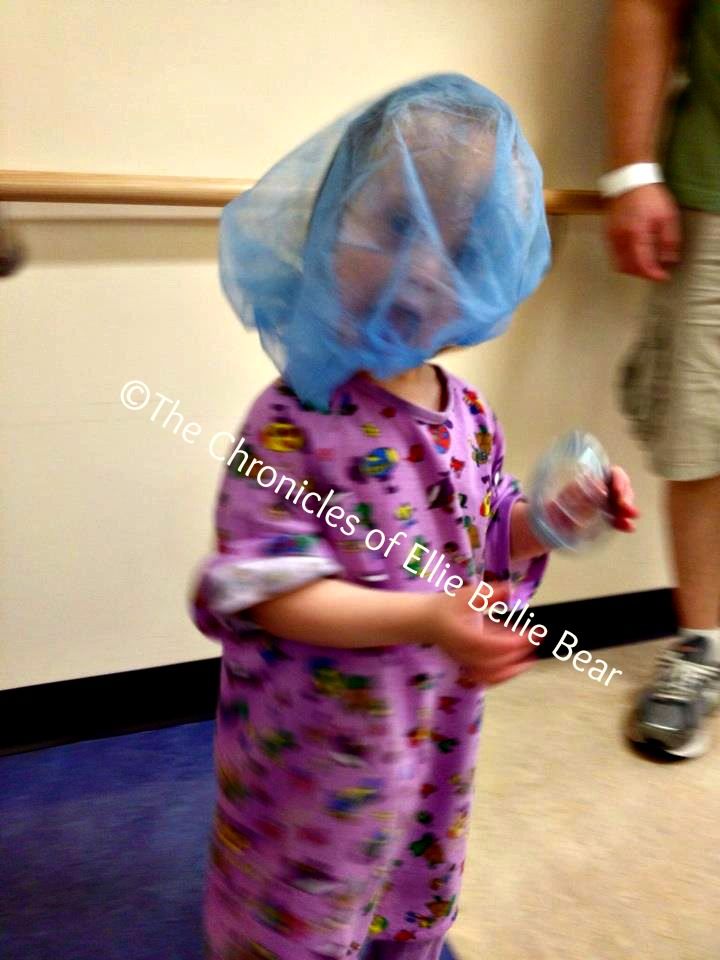
Busting out!  Poor thing was feeling pretty cruddy, but she was happy
to be headed home after a night in the hospital.

I was extremely concerned about how things were going to go overnight- would she require oxygen since she is so swollen?  Would she be in a lot of pain?  Would she sleep at all?  Again, it was needless worry for our Bearity Bear had oxygen saturations from 91-94% for the entire night!!!  To me, that is proof that her surgery was a success because pre-surgery, she would sit at 81% for most of the night.
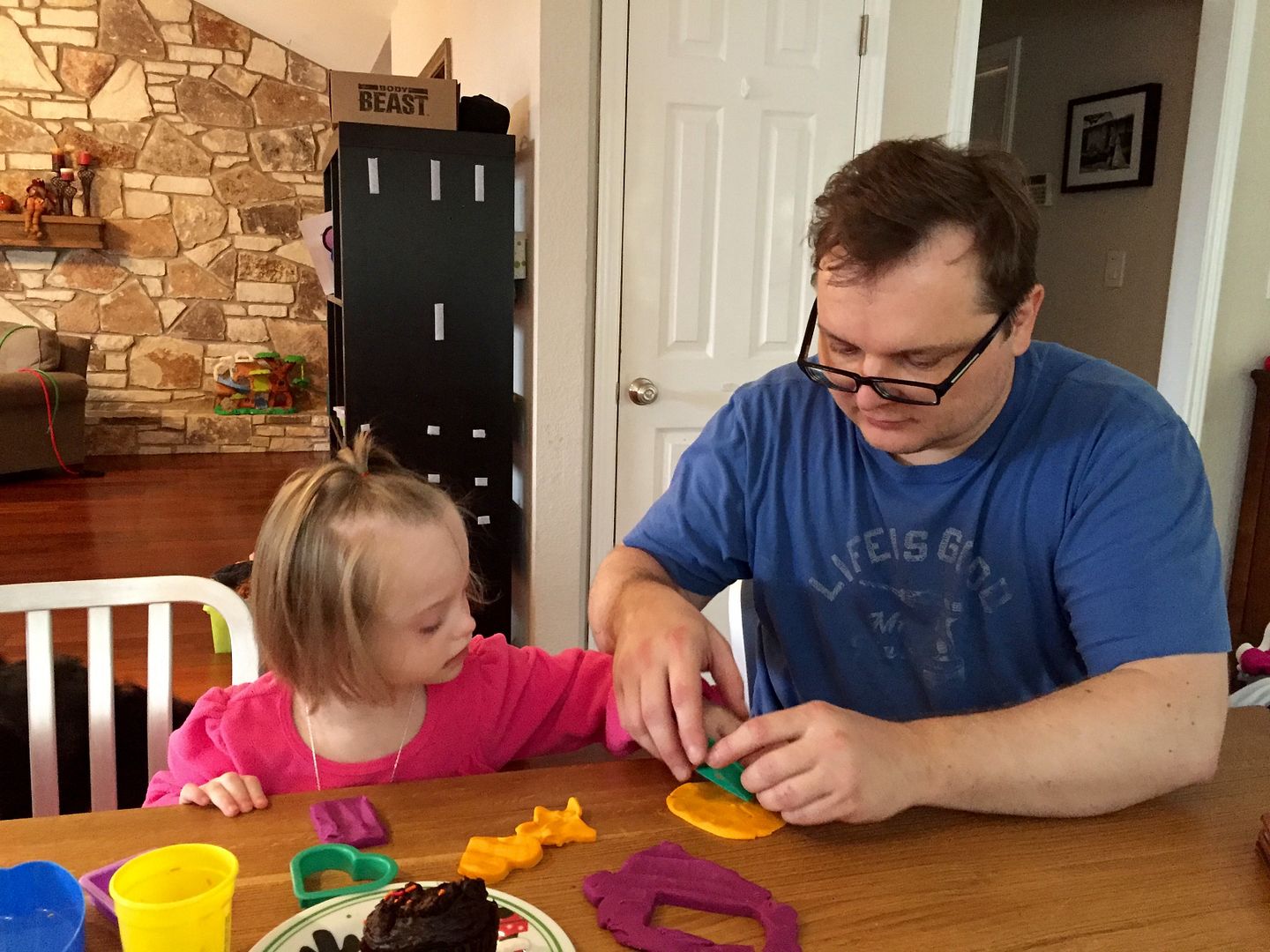
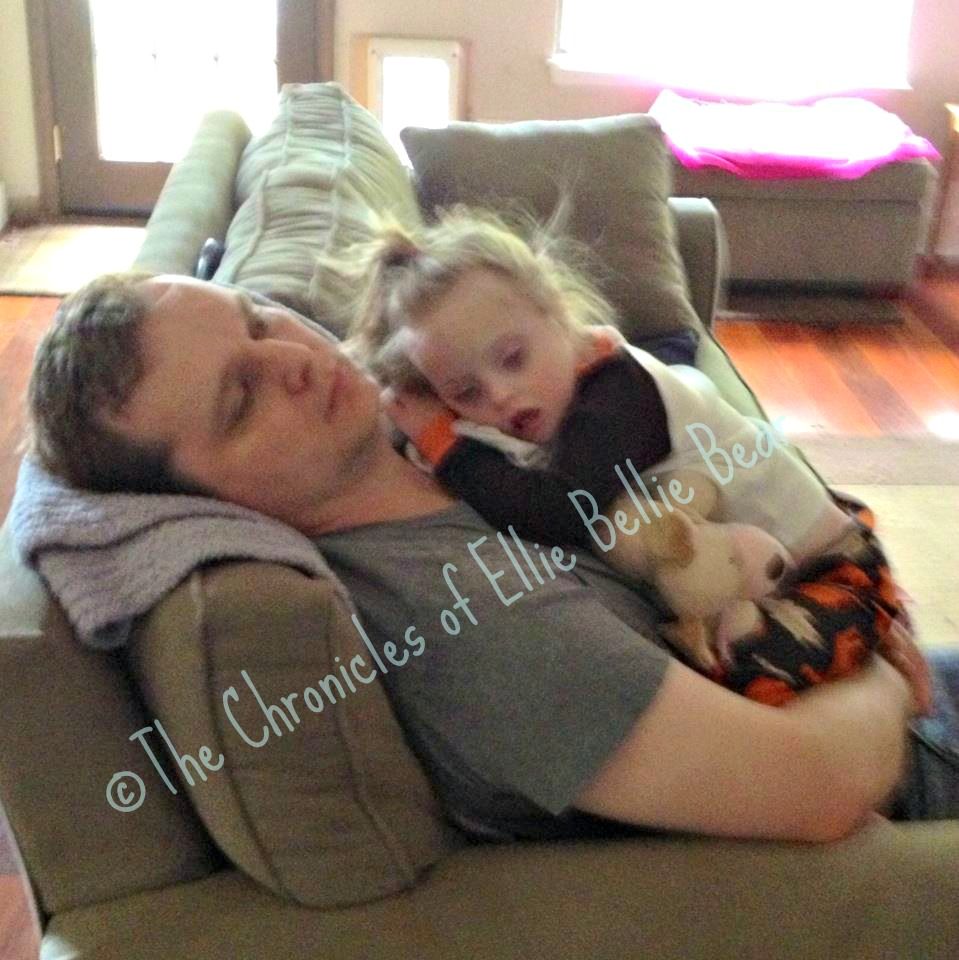
Play-doh pajama time with Daddy!  Her cheeks were pretty swollen.


A traditional tonsil and adenoidectomy recovery usually takes 7-10 days with an increase of pain around day 5-10 depending on when the scabs slough off (it was day 6 for Ellie a few years ago).  With the lingual tonsils, there is less raw space and as such, less pain.  The surgeon stated that normal recover for a lingual tonsillectomy is 5-7 days.  Ellie's recovery took about 6 days with her returning to school the following Monday.  I would say that post-op day 3 (Thanksgiving day, of course) was by far the worst where we had a hard time controlling her pain and that left her miserable, crying and rather agitated.  As for the glossectomy, the tongue heals quickly - in a manner of 4-5 days.  It did give her some seriously rank breath that lasted nearly 2 weeks - as in enough to pass out from if she were to breath on you!  She is still snoring a bit, but I believe that is because she has some drainage and congestion due to her throat and tongue healing.  We will have a follow-up sleep study in about 3 months to re-evaluate her sleep apnea.

So that was our November and now I can hardly believe that December is already here and soon 2016!


Follow us on Facebook! https://www.facebook.com/pages/The-Chronicles-of-Ellie-Bellie-Bear/216738345037166

Thursday, October 29, 2015

Obstructive Sleep Apnea - surgical management in children; lingual tonsillectomy, glossectomy

When I first started working as a nurse practitioner, I took a position at a busy, urban pediatric ENT clinic.  I used to spend my days in pre-/post-op appointments and teaching parents about various ear, nose, and throat surgeries.  Now, I am the on the other side, the parent side. It is a weird feeling.  On one hand, I feel more prepared than ever given my background.  On the other hand,  it is a great source of stress to know all the details of the various ENT procedures / anatomy related to my daughter's ears and airway issues.  Sometimes, it just means more to needlessly worry about and get fixated on.

Today, we finally had our appointment with an ENT specialist who works specifically with children who have Down syndrome and sleep apnea.  She is amazing and very knowledgeable.  I know that Ellie is in safe hands.


Rather excited about the horse picture in the waiting room
Note: I took a quick pic first and then told her no feet on the chair - priorities

Background:
Ellie was diagnosed with Obstructive Sleep Apnea via a sleep study aka polysomnography back in January.  Essentially, Ellie would have pauses [apnea] in her breathing while asleep.  Even more worrisome is that she has very slow, very shallow breathing. This means she isn't taking in adequate oxygen to feed her brain and that she isn't exhaling enough carbon dioxide. [hypopnea] Her oxygen saturation would sit in the low 80s for most of the night.  Normal oxygen saturation are 97-100%.  This is a toxic situation that leads to behavior issues, frequent night wakings, and possibly even be part of her failure to thrive.

Photo from Ellie's sleep study.  
Health Risks related to sleep apnea
Photo: www.sleepapneadisorder.info


In most cases of sleep apnea, the child's tonsils and adenoid are removed.  These fatty tissues can be the source of airway obstruction.  By removing the tonsils and adenoid, you are keeping the upper airway open.  Ellie had both of hers removed 2.5 years ago.  It actually resolved her sinus infections and eliminated the need for further sets of ear tubes because the adenoid was so large, it was blocking drainage from the sinuses and Eustachian tubes (a part of the ear).

Beauty Sleep: Tonsils, Adenoid, and Ear Tubes - obstructive sleep apnea and chronic sinusitis


CPAP:
Because we already performed an tonsillectomy and adenoidectomy, we opted to treat Ellie's sleep apnea and hypopnea with sometime called a continuous positive airway pressure device aka CPAP.  It was quite the trial.  Getting Ellie to put on the mask let alone hook it up to the machine and turn it on, was a nightmare.  Social stories.  Pictures.  Bribery with M&Ms. Enlisting the help of therapists and a sleep mask technician.  None resulted in Ellie donning on the mask for more than a few minutes.

As you can see, Ellie was not a happy camper.

CPAP for obstructive sleep apnea


CPAP Failure:
Now, this is where things get interesting:
In most cases, the removal of the tonsils and adenoid "cure" obstructive sleep apnea in up to 75% of people.  It is closer to only 25-45% in kids who are obese, have asthma or have Down syndrome.  Kids with Down syndrome are more prone to having persistent sleep apnea even after a T and A because of their small jaws, smaller mid faces, larger tongue or a narrow, high-arched palate.   So when something like CPAP fails, other options must be explored.

Obviously, you don't want to go hacking away at random structures of the child's airway.  How do you know where to begin?  Back at the beginning of September, Ellie had a Cine MRI under sedation.  Basically she was put into a sleep-like state and had a special moving MRI that is used specifically to look at how the head & neck anatomy acts during sleep.  This is a way to pinpoint exactly what structures (tongue, palate, tonsils, etc). are collapsing while sleeping and cutting off the airflow.
Ellie was pretty loopy coming out of sedation post MRI.  She wanted to rip our her IV until she discovered her pulse ox on her thumb.  Oooh light. . . pretty. . . .  Sometimes I think that sedation is rougher than anesthesia for Ellie.

Cine MRI:

Ellie's Cine MRI revealed that she has a large tongue aka macroglossia - at the base or back of the tongue and at the top of the tongue is large enough that when laying down it abuts the palate.  It also showed Epiglottis Insufficiency - basically where the epiglottis closes off the airway.  The epiglottis is located just below the tongue and it covers the trachea/airway during swallowing.  If the epiglottis is fully closing during sleep, it is blocking the trachea and decreasing airflow.

Function of Epiglottis
Photo: www.rise.duke.edu
Tongue causing obstruction of the airway while asleep

It was theorized that the epiglottis insufficiency is the result of enlarged lingual tonsils.  These are tonsils that you cannot see when you open your mouth.  Most people don't even realize we have these tonsils, as the lingual ones sit just below the tongue base.  If they are large, they cause an obstruction and they can also push the epiglottis closed while asleep.  It is thought that more than 30% of kids with Down syndrome who have persistent sleep apnea have large lingual tonsils.  Ellie has large lingual tonsils.

Photo: Anatomy of the Respiratory System Institut Pendidikan Guru Malaysia; slideshare.net


Goody.

Plan:  SMILE
Apparently, everything Ellie is having done can be summed up as the SMILE procedure.  It sort of cracks me up - SMILE!  We are going to do a SMILE on Ellie! Funny, I don't think we will be smiling when the day arrives.  SMILE = submucosal minimally invasive lingual excision

The ENT doc is going to remove the lingual tonsils.  This is going to go a lot like her previous tonsil/adenoid surgery, but with a slightly shorter and hopefully less painful recovery time (5-7 days average recovery).  I am pretty much going to follow what I did way back in April 2013 when she had her T and A with regards of what to bring to the hospital and how to make her comfortable post-op.

Tonsillectomy and Adenoidectomy recovery strategies for children with Down syndrome  - prepare for day of surgery and for post-op.

The other procedure that will be performed at the same time is a posterior-midline glossectomy, which is a fancy way of saying "we are going to make the back of her tongue smaller /less bulky".  This is actually a surgery that I am not fully familiar with, but it has been gaining in popularity among pediatric patients these past 15 years when CPAP and Tonsillectomy fail to alleviate sleep apnea. I will spare you the details, but believe it or not, it is probably the less painful of the 2 surgeries and the recovery time is only 4-5 days.

Photo: www.singhealth.com.sg

I am not exactly thrilled about any of this, but I know it needs to be done.  Sleep apnea is no joke.  It affects all health systems negatively.  Ellie's doctor is an excellent doctor (when doing research - I discovered several articles and studies conducted by her) who will take good care of the Bear.
So now I have approximately 28 days to have mini panic attacks on a daily basis.  Oh Ellie. . . why must things be so difficult?!

References:

Propst, Evan (2015). Lingual tonsillectomy and midline posterior glossectomy in children with obstructive sleep apnea.  Operative Techniques in Otolaryngology http://www.optecoto.com/article/S1043-1810(15)00009-3/fulltext

Ishman, S. (2012). Abstract: Pediatric Sleep Apnea and Surgery; Beyond tonsillectomy. Audio-Digest Ototlaryngology. http://www.audio-digest.org/adfwebcasts/pdfs/ot4518.pdf

 photo IMG_2291_zpsudykfi0h.jpg

Follow us on Facebook! https://www.facebook.com/pages/The-Chronicles-of-Ellie-Bellie-Bear/216738345037166

Monday, January 20, 2014

Tonsillectomy and Adenoidectomy Recovery Strategies for Children

*I apologize in advance for some missing photos - I used Photobucket for free as a means to store my photos and they are now holding a few hundred pics of mine for hostage unless I pay for an expensive plan and I also managed to lose half my photos from my computer*

A few months ago I wrote the world's longest Facebook message to a dear blogging friend of mine whose adorable rockstar little boy (Super Joe!) was getting ready to undergo a Tonsillectomy and Adenoidectomy.  Seeing as Ellie recently went through her upper airway carving surgery back in April and my prior background as working as an ENT nurse practitioner, she thought I might have some good tips.  Well, I don't know if they are good are not, but here they are. . .graciously reposted from her blog post on Cowgirl Up! Seriously, check out her blog.

As with anything I write here, this does NOT substitute medical advice given to you by your child's health care provider.  If you have any questions, please contact your child's doctor.

"this surgery will be a breeze!"

Tonsillectomy and Adenoidectomy Recovery Strategies for Children with Down Syndrome


1. The pain varies from individual to individual. It depends on how "attached" the tonsils are to the throat. Some kids have huge wonking tonsils but they just hang by a thread. Other kids have smaller ones (or large ones) but they are firmly adhered to the throat by a whole lot of tissue. You will not know for sure how attached they are until the surgeon actually removes them. As in, you cannot tell just by looking into the throat. . .
This is why some kiddos are bouncing off the walls two days later and why others (like my kiddo) moaned and groaned and laid around.

2. Hospitals have different rules around the US. Bear deserted (had low oxygen levels) a lot during sleepy time. 79-88%. She got to have some oxygen on over night. Surprisingly, they let her go home. It was up to the doctor and the thought was Bear was oxygenating low pre-surgery (due to obstruction from her honking tonsils and crusty adenoid) so let the poor kid recover at home. At CHOP, kids have to be satting at 95% without oxygen even when asleep. This can lead to living in the hospital for a few days. Honestly, if we had been at CHOP, we would still be there. . . okay I am exaggerating, but we would have been there a few days at least going bonkers. My advice is to charge the iPad, bring the charger, bring spare clothes because you just do not know how long you will be camping out. 

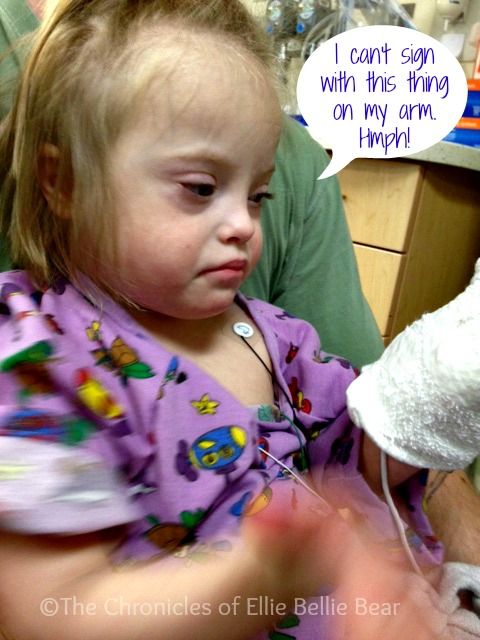
She is watching Signing Time on the iPad.  It was the only way we could keep the IV in and the electrodes on.

3. The more hydrated the child is, the easier the recovery.


When the surgeon removes the tonsils and the adenoid, scabs will form. Keeping those scabs moist decreases pain. Hydration also prevents trips to the ER due to dehydration. Fluids include semi-solids too--think ice cream and apple sauce. I had the Bear chugging apple sauce because she wouldn't drink anything else. STRAWS--okay some docs say no to straws after T and A while others say no restrictions. (just as some say they can go to therapies when feeling better while others say no for 2 weeks).
4. The 5-10 Day Mark:

As with any scab, it will fall off--this occurs 5-10 days post op. When the scabs fall off, it hurts and there is a risk for bleeding. This why children often need an increase in pain meds. That being said, some kids are running around like wild banshees and you would never know that the scabs fell off.
With Ellie, on day 6 she slept. A LOT. I think she was only up for 6 hours total. She also wouldn't drink. That was the only day she would not drink. That was the day she lost most of her scabs. She lost the remainder of the scabs after week 3 and I didn't even notice.


5. MUCUS or SNOT or DROOL or all of the above

It will be thick. Really thick. And copious. Surgery is surgery and as you already know, cutting into tissues is trauma and trauma leads to swelling and fluids. Expect to see some snot for several weeks post-op. Expect to hear some snoring as well--remember the swelling.


6. Don't forget the iPad and spare clothes. A few sets.
Yes, I have mentioned this already, but it is important! You know what is fun? Post op emesis (vomiting). What is even more fun is dried blood post-op emesis. Right after you change into the bedtime clothes. Bring several shirts. Between the ice cream, the snot, the drooling, and the vomiting, you will want something semi-clean and non-smelly to sleep in. I learned this the hard way. The iPad is so that you can google everything that looks funky. Or to play Signing Time over and over and over again. 


7. This may be the most important one for pain and recovery: CHEW CHEW CHEW.

I know this sounds strange, but you want to keep the jaw, cheeks, and neck muscles loose and relaxed. Especially the neck. Tensing up will increase the pain. Relaxation helps with healing. Gummies, fruit snacks, whatever to move those muscles. I avoided all red items--red juices, red pedialyte, red gummies, red jello.


Ellie Bellie Bear's TandA posts from April:

Beauty Sleep: Tonsils, Adenoids, and Ear Tubes-Obstructive Sleep Apnea and Chronic Sinusitis

A Somewhat Rough Recovery-tonsil and adenoid removal

A Few Bumps in the Road-Pnemonia 

Photobucket

Cecostomy Tubes R Us

Here we are - two posts in 30 days! It's scandalous, I tell you!  Seriously though, I bet you all thought that I abandoned ship and woul...